Categories
Architects Architecture Country Houses Design People

Francis Johnston + Townley Hall Tullyallen Louth

Thrill of the Chaste

An immaculate concept, a gorgeous late Georgian flowering. Townley Hall deep in the Boyne Valley came about in the closing years of the 18th century. Its architect Francis Johnston designed Rokeby Hall, 17 kilometres north of Townley Hall, a decade earlier in 1786. The former is a smaller version of the latter. Both are of a spare patrician architecture so appealing to the modern eye. Plain planes. Townley is an achingly svelte seven bay by seven bay 27.5 metre square block.

The architect conceals and reveals scale and massing as the viewer moves round the outside. This is a four storey house masquerading on three sides as a two storey building. Attic dormers lurk behind a solid parapet in a similar arrangement to the contemporaneous Castle Coole, County Fermanagh, except there the dormers peep through balustraded gaps in the parapet. Townley is Castle Coole taken to next level Grecian severity in a case of keeping up with the Lowry-Corrys. Francis’ brother Richard was the original architect for Castle Coole: he was replaced by the celebrity architect James Wyatt. There is another Fermanagh link: the client Blayney Townley Balfour married Lady Florence Cole in 1794. She was from Florence Court, a neighbouring estate of James Wyatt’s masterpiece.

Townley Hall is an essay in structural rationalism, a formal stone box grounded by rolling countryside. Recent semiformal planting softens the grey to green juxtaposition. Unencumbered by unnecessary architectural frippery, Francis employs taut lines. He let’s go – just a little – with the kitchen wing. A collection of curves carefully enriches the wing’s fenestration: recessed arches, roundheaded windows, segmental arched tripartite mezzanine windows, a bow window. It’s not just an august purity auguring minimalism that defines Townley. Workmanship and materiality are also top notch. The facing ashlar was quarried from nearby Sheephouse. It has lower absorbency than most limestone. Mortar is barely visible between the masonry. Metal rods reinforce the slimmest of glazing bars. A mid storey string cornice and Greek Doric eaves cornice relieve the expanse of wall.

A tetrastyle Doric portico leads into the entrance hall which has twin Doric chimneypieces – more restrained versions that those in Castle Coole. That’s a theme developing in this article. Rectangular plasterwork wall panels resemble vast empty picture frames. A coffered ceiling adds to the room’s crisp angularity. Straight ahead – silent drum roll – is the rotunda, a nine metre diameter glass domed cylinder forming the core of the house. A swagger of genius. A swoop of plasterwork swags and skulls. Irish design at its most suave. All the plasterwork whether naturalistic or geometric is of shallow relief. There are two coats of paint on the rotunda walls: the current 1920s creamy beige over the original stone grey. The ribbed dome casts a spidery web of shadows which leisurely climbs the staircase as the afternoon progresses.

An interlinking ceiling rose pattern in the drawing room is similar to the overhead plasterwork of the dining room in Castle Coole. Like all the main rooms around the rotunda it is 7.3 metres deep. This layout allows all the main rooms to have natural light while the rotunda is top lit. Rokeby Hall is similarly laid out and equally bright. It is an efficient arrangement removing the need for corridors. Andrea Palladio’s 1560s Villa Rotunda outside Vicenza is an obvious source of inspiration although the dome of Townley is hidden behind the attic floor rather than being on full display. Surprisingly Francis’ drawings illustrate the final rationality of layout and simplicity of design was achieved through an evolutionary process. For example, the more elaborate Ionic order (which James Wyatt used for the portico of Castle Coole) was replaced with the plainer Greek Doric for the portico. Francis was clearly a master of the Golden Ratio.

A set of early 1900s photographs courtesy of the Irish Architectural Archive includes views of the interior. Furnishings were suitably classical and restrained. Chinese wallpaper in the south facing drawing room is a rare flush of extravagance. The boudoir and dressing room over the drawing room overlook the parkland. They are one of five family suites clustered around the first floor rotunda landing. On the floor above, the view from the servants’ dormitories is the backside of the parapet below a sliver of sky. The only unobstructed attic windows are in the west facing barrack room which looks down into the courtyard: guards needed to be on watch.

In 1957 the family sold the house and 350 hectare estate to Trinity College Dublin for use as an agricultural school. Since 1977, Townley and its immediate 60 hectares has been a residential study centre owned by the School of Philosophy and Economic Science. A single level extension (visible as one storey on the north front) was recently completed over the kitchen wing plus a double height access link to the original house. The two main conservation schools of thought are to either design an extension that blends in with the host building or one that contrasts with it. The current Irish notion strongly favours the latter. Oh the architectural profession’s fear of that ultimate sin: pastiche! That’s despite every other modern glass building being derived from Philip Johnson’s Glass House in Connecticut and its 70 year old ilk. RKD Architects of Newmarket Dublin secured planning permission for an extension that consisted of similar massing to that executed except the courtyard facing elevation was a dormered mansard. RKD proposed Georgian style sash windows throughout.

Treasa Langford of Dúchas Heritage Service commented on the application, “The finishing of the north wall is not specified; however, the construction is specified as exposed uncoursed rubblestone, which would appear to be inappropriate on a cut stone house such as Townley Hall. We would recommend a ruled and lined nap lime plaster finish without use of cement.” Her opinion is based on the view of sympathetically blending old and new. It could be counterargued that rubblestone would be suitably subservient to the cut stone of the grand main block, emphasising the ancillary nature of the wing.

A decade later, MVK Architects of Fitzwilliam Square Dublin’s design also secured planning permission and this time it was built out. Their approach is very different. The design concept is to add an identifiably contemporary layer to this historic property. Subordination and deference are common themes of both practices’ thinking. MVK’s has neither a mansard nor Georgian style glazing bars but the window openings are classically positioned and proportioned.

Michael Kavanagh of MVK Architects relates, “The choice of material was based on aesthetic as well as practical considerations. Natural zinc has a light grey colour – from historic photographs it appears the slate on the original roof had a similar light grey colour. The material is not intended to match the limestone colour but rather be complementary to it. Zinc is natural, hardwearing, long lasting and difficult to puncture. These characteristics make it ideal for long term weatherproofed cladding. It is stiffer than lead or copper and consequently allows for the crispness of detailing which is intended throughout.” This metal envelope is fixed on plywood decking across battens to form a ventilation zone. The zinc is fitted in strips of varying widths using a staggered but repeating rhythm which reflects the use of differently sized limestone blocks on the main house exterior.

The best example in Ireland of a Modernist addition to a neoclassical building is of course the Ulster Museum Belfast extension. Edinburgh architect James Cumming Wynnes won the 1913 competition for the original museum. The exterior displays fairly ornate Beaux Arts decoration. In 1964, London architect Francis Pym won a competition to extend the museum. His highly inventive design is at once contextual and disruptive. He draws out the neoclassical detailing such as cornices and string courses which then collide with abstract cubic concrete blocks expressing the layout of the galleries inside. Francis’ dramatic work is unsurpassed in its genre. Surprisingly, he worked in church conservation and his only other recorded built form is a gazebo somewhere in England.

This is an article of superlatives. The O’Connell Wing of Abbey Leix in County Laois is a study in how to do it right. Architect John O’Connell’s masterful 1990s reimagining of an unfinished 1860s wing by Thomas Henry Wyatt (an Anglo Irish distant next generation relation of James) is a lesson in improving what’s there already. Client Sir David Davies explains, “This extension was never built as planned but the remains of the Wyatt scheme – a low unadorned wall to the right of the main house was a disfiguring distraction, an issue O’Connell resolved by puncturing the walls with windows and adding architectural ornament.” John O’Connell was also responsible for the late 20th century restoration of Castle Coole. This is an article of connections.

Sympathetic contextual additions; visibly contemporary extensions; dramatic architectural interventions; subtly remodelled wings – they all have their place and supporters. English Poet Laureate and architectural historian Sir John Betjeman once stated, “I have seen many Irish houses, but I know none at once so dignified, so restrained and so original as Townley Hall in County Louth.” More than 230 years after it was finished, such is the strength of Francis Johnson’s design, capturing the spirit of a future age, it still possesses dignity, restraint and originality.

Categories
Architects Architecture Art Design People Restaurants Town Houses

The Wallace Collection Marylebone London + John O’Connell

Quotes of Armour

Despite being a Sèvres urn’s throw from London’s Oxford Street, The Wallace Collection at Hertford House always radiates an air of calm and civility. Perhaps it’s the sylvan setting of Manchester Square. Maybe it’s the muted acoustics of the Courtyard Restaurant. But most likely it is the dignity – even with some daring moments – of the interiors that secures this aura of being far from the madding crowd. The latest room in the former home of the Victorian collector Sir Richard Wallace to shine once more is the Great Gallery. It’s December 2014 and John O’Connell, Founder and Director of John J O’Connell Architects, is about to give a private tour of The Wallace Collection. The municipal museum is once more a sumptuous townhouse. Over to John:

“Sir Richard Wallace planned the internal spaces around the main staircase which has a balustrade from the Hôtel de Nevers in Paris. In principle, each room is enhanced to stress the domestic or private mansion aspect of the main house. For example interconnecting doors between rooms have been reinstated and indeed in the Study we have introduced an entirely new false door to visually balance the existing doorway on the other side of the fireplace. Our main purpose is to provide an augmented setting for the Collection. It is not about re-creating rooms as they were, no, but rather re-presenting them for today’s visitors and scholars. The colour of the Dining Garden Hall is a quieter silver grey. You can’t have hectic colours all the time! Curtains should cascade and be three dimensional: they should come forwards and backwards.”

“This is the size of a city block, the Great Gallery, so it’s an extraordinary beautiful room and what we’ve done is gone and looked at the archived photograph of the room as it was with this lovely laylight which had to be abolished at a certain moment and now with modern technology we can again have this great laylight. This is where you have studio glazing at the top of the roof and it in turn lets light down onto this magnificent daylight so in other words it has a huge amount of natural light falling into the room.”

“It’s not wallpaper on the walls. It’s the most wonderful possible fabric, silk, and it’s not just damask, it’s a brocatelle, so it’s got even more silk in it! I think that to, as it were, bring the gallery forward into the modern age, you need to get the best possible conditions: lighting, climate control, security, fire safety compliance, decorative effects, so you can bring all of that into this great space. You could only do that if you go right back and lift the roof off because that’s what happened here. You see, the entire roof of the Great Gallery was taken off and what we have here is a whole new room within the gallery space because this has the technology almost of a railway terminal, when you see the supporting structure, and yet inside it is so beautiful.”

“Architectural features must do at least three jobs. The oculi in the latticed cast plasterwork punch through the cove: vertical stop, start, stop, start, all the way round the room. They also let more light into the room and act as the return path for the air conditioning. Reinstating wainscoting has curatorial importance. The paintings come to life against coloured fabric above the dado rail and the light coloured wainscot is appropriate as a backdrop to furniture. The gilt fillet of the wainscot is more pronounced than in the preceding galleries. If it was too small it would look titchy; if it was too over the top it would look bonkers. The wainscot must flow along. The Great Gallery enshrines everything we have learned during our 19 years working at the Collection. Everything bar the floor is new.”

“I think first of all The Wallace Collection is so multifaceted, the armour, then of course furniture, particularly Boulle, as an architect we love Boulle furniture, this is what we really want! The great thing is here the parameters are set. You can move everything but you cannot acquire and you cannot dispose which is marvellous, so it’s like a game of chess all the time. Everything is of equal importance. The placement of objects is just so important.”

Earlier that year Country Life had featured the Great Gallery in its 10 September edition hailing the “triumphant revitalisation”. The hang has long been recognised as one of the world’s best displays of Old Masters. Only two of the principal galleries attached to aristocratic London townhouses survive: Apsley House in Piccadilly and Hertford House. But it was John’s work which really enthralled the magazine. Michael Hall writes in Gallery Tour: The Great Gallery at The Wallace Collection:

“The present restoration – which forms a climax, but not the conclusion, of a comprehensive programme of refurbishment of the galleries begun under The Wallace’s former Director Dame Rosalind Savill in 2000 – has been paid for by a single donation of £5 million by the Monument Trust, in memory of the Honourable Simon Sainsbury, a major donor to The Wallace and a former Trustee. As with the other galleries, the design work has been carried out by John O’Connell Architects.”

“At first glance, it may seem that nothing has changed, but, in fact, almost everything has. Even the gallery’s two doors, at the far ends of the south wall, are not in their original places. They were formerly close to the corners of the room, creating a dead space in the angle; now that they have been moved closer together, there is room to hang large pictures on either side of them. In the 1978 to 1982 restoration, the walls were hung with a coral coloured fabric, which, by 2012, had faded. It has been replaced by a small patterned crimson damask woven by Prelle in Lyon.”

“Inspired by the great Victorian private picture galleries of London – continuing a tradition that goes back to the 17th century – it provides a satisfyingly rich and deep toned backdrop to the paintings. The main seat furniture in the room, an early Louis XVI set of chairs and settees, has been reupholstered to match. One subtle but striking improvement is the addition of a chair rail and dado, which the room had never possessed before. This anchors the furniture to the setting, but, more significantly, provides a strong architectural base for the hang of the paintings, preventing any feeling that they are floating on these huge walls.”

“Most impressive of all is the coved ceiling. An entirely new design by John O’Connell, it reintroduces indirect sunlight by means of oval laylights in the cove and a large laylight in the centre of the room. This has been made possible by advances in air conditioning technology: the new system installed as part of the refurbishment is very much smaller than its 1978 to 1982 predecessor. Daylight brings the room alive, and lends sparkle to the paintings, enhanced by an entirely new lighting scheme – predominantly LEDs – by the engineers, Sutton Vane Associates.” Michael Hall describes the Great Gallery as “one of London’s greatest rooms”.

Ros was Director from 1992 to 2011. Her appointment was approved by Prime Minister John Major because The Wallace is a national museum. She had the dual task of creating the optimal 21st century museum visitor experience and meeting the expanded expectation of the Government. Ros breathed light and life into the museum, excavating the basement and glazing over the courtyard. Two temporary exhibition galleries, a theatre, a learning studio, a library, a meeting room and rows of individual bathrooms were inserted into the basement. The new spaces combine the practical with the scholarly. Most of all, Ros wanted the objects to sparkle and to bring a new domestic intimacy to the staterooms. And so she called upon John and together they embarked upon the golden age of transformation – at pace. Visitor numbers more than doubled.

At her Memorial Service in St Marylebone Anglican Church in May 2025, the Reverend Canon Dr Stephen Evans said, “Rosalind is not only renowned for her services to the study of ceramics, but also someone once described as ‘the most distinguished woman museum director of the western world’. Not only the keeper who transformed The Wallace Collection. A trusted advisor. A wise, exciting and imaginative teacher. An engaging meticulous writer whose public service was enlivened by ebullience, verve and passion.”

It’s August 2025: asparagus and feta mousse followed by orange and poppyseed cake are being served in the Courtyard Restaurant. A time for reflection in and on and about a monumental cultural legacy. The late great Dame Rosalind Savill was an inspirational scholar of European decorative arts, a visionary museum director, and a human being of such intelligence, empathy and grace. She called John “my genius architect”. His practice would later be responsible for redesigning major country house estates such as Montalto in County Down. What Ros and John achieved together at The Wallace Collection remains a touchstone of excellence for museums everywhere. Dancing to the music of time.

Categories
Design

Lindy Guinness Marchioness of Dufferin + Ava + Abbey Leix Laois

Holland Days Source

Neither a Monday evening nor (apropos to an Irish shindig) drizzly weather could possibly dampen spirits. Not when it’s a party co hosted by the dashing Sir David Davies and the lively Lindy Hamilton-Temple-Blackwood, last Marchioness of Dufferin and Ava. Her Ladyship is the artist known as Lindy Guinness. The setting is another draw: the mid Victorian splendour of Lindy’s Kensington city mansion (townhouse being too humble a term).

Banker and businessman Sir David is President of the Irish Georgian Society. In between rescuing companies and country houses, he leads a high profile social life, counting Christina Onassis among his exes. Like all the greats, he once worked at MEPC. This party is a book launch celebrating the publication about his primary Irish estate, Abbey Leix in County Laois. Averys Champagne is served with prawns and pea purée on silver spoons. There’s a metaphor lurking in that cutlery.

Two vast full depth bay windowed reception rooms on the piano nobile of the Marchioness’s five storey house easily accommodate the 100 guests. One room is hung with her paintings. Renowned fine art specialist Charles Plante is an admirer: “Lindy Guinness brings forth abstraction in painting that mirrors the Cubism of Cézanne and Picasso. Her works are irresistible.” The staircase walls are lined with David Hockney drawings. In fact there’s 20th century art everywhere. Lucien Freud was Lindy’s brother-in-law and old chums included Francis Bacon and Duncan Grant.

This party’s getting going. Everyone one should know is here. Interior decorator Lady Henrietta Spencer-Churchill is admiring the garden. Sir David’s glamorous sister Christine and her son Steffan are chatting in the entrance hall. They’re from Ballybla near Ashford, County Wicklow. Turns out they’re big fans of nearby Hunter’s Hotel. Writer Robert O’Byrne is conversing with designer and collector Alec Cobbe in the drawing room. “I still live in Newbridge House when I’m in Ireland,” confirms Alec. Broadcaster Sean Rafferty is busy playing down his former illustrious career in Northern Ireland where he’s still a household name. “You must visit my cottage in Donegal.” A party isn’t a party without interior decorator extraordinaire Nicky Haslam. “I didn’t realise I was such a style icon to you young guys!”

Fresh off the treadmill finishing the definitive guide to Russborough in County Wicklow, a mighty tome on another Irish country house, Abbey Leix was erudite architectural historian William Laffan’s next commission. Sir David bought the estate from the 1st Earl Snowdon’s nephew, 7th Viscount de Vesci, for £3 million in 1995. William’s book celebrates the restoration of the house and the rejuvenation of its 485 hectare estate.

“Thank you to Lindy for inviting us to her home,” Sir David announces. “It’s very much a home not a museum. Someone asked me earlier was this my house. I wish it was! The only thing better than a double 1st is a double Guinness! Lindy is a Guinness by birth and a Guinness by marriage. And thank you to William for all the hard work. I asked him to write 100 pages and three years later he’s written hundreds of pages! The photographs are beautiful but do make sure you all read a bit of William’s great text too!”

The Knight of Glin’s widow Madam Olda FitzGerald, mother-in-law of the actor Dominic West, appears. Sir David nods, “Desmond FitzGerald was a great inspiration to me. Bless him, bless the Irish Georgian Society. I feel very honoured to follow in his footsteps as President. There are three other people I wish to thank without whom the restoration of Abbey Leix wouldn’t have been possible. John O’Connell, the greatest conservation architect in Ireland. Val Dillon, the leading light of the antiques trade. John Anderson, former Head Gardener of Mount Usher Gardens and Keeper of the Gardens of Windsor Great Park. I had to prise him away from the Royals!”

“Bravo!” toasts the Marchioness. Her blue eyes twinkling, her jaunty scarf knotted as tightly as the curls of her silvery hair, Lindy chats about her other property, the very private Clandeboye, a late Georgian country house on an 800 hectare estate in County Down. She’s especially proud of her yoghurt production on the estate. “My mother-in-law gallantly rescued Clandeboye from debt and brought in the flamboyant designer Felix Harbord to do up the house in the 1950s. He designed the American Plantation style porte cochère with its four white Doric columns. The blank entrance wall of the 1st Marquess’s remodelling must have previously given such a drab first impression of the house. Felix also decorated Luttrellstown Castle, my aunt’s house near Dublin. Clandeboye is a house of dreams and enchantment that fills my thoughts and – now as I am older – the pleasure of being part of it grows greater.”

Lindy keeps talking, “I can remember arriving for the first time in 1962 and walking up the 1st Marquess’s halls in blurred amazement. I was a youthful debutante and had come to stay for a Clandeboye weekend. This first summer visit passed in days of happy exploration. We had arrived late in the evening when all was dark. I remember waking the following morning and looking out from my bedroom called Rome to see a magnificent interlocking landscape of greens that led down to a lake. It was especially beautiful – there were low horizontal bands of Irish mist allowing only certain parts of the landscape to be sharply defined. Oh you’ve got me reminiscing!” The Averys Champagne flows.

That was 2017. Where are the main players now? Just three years after this party, the hostess who was born Serena Belinda Rosemary Guinness died aged 79. The marquessate defunct, Sir John Blackwood, 5th Baron Dufferin, a descendent of her husband’s family, was upgraded to take over Clandeboye and 4 Holland Villas Road. Sir David Davies sold Abbey Leix in 2021 and his main base is Killoughter House near Ashford, County Wicklow. John O’Connell acted as architect for its restoration. Charles Plante is now recognised as an international tastemaker. In 2025 Robert O’Byrne published The Irish Country House A New Vision. Featured piles of the Emerald Isle include Killoughter House and Moyglare Manor, a former hotel near Maynooth in County Kildare. Madam Olda FitzGerald continues to add sparkle to high society events, not least Alfred Cochrane’s legendary 2024 summer garden party at Corke Lodge in County Wicklow. “A party is only as fabulous as its guests!” quipped Ireland’s most stylish host. William Laffan’s book on Abbey Leix became an instant collector’s item and is currently valued at over eight times its original price of £40.

Categories
Architecture Art Country Houses People

The Pollocks + Mountainstown House Navan Meath

Unbright Light

“Mountainstown House has been the subject of a number of vague and inaccurate accounts published over the last few decades. With the aid of newly discovered historical documents, it’s time to set the story straight,” declared the Issey Miyake paper trousered 24 year old Associate Editor of Ulster Architect with all the confidence of youth. The June 1998 article continues, “Bruce Campbell, Professor of Medieval Economic History at Queen’s University Belfast, compares Mountainstown to Eltham Lodge, an early Dutch style house in Kent. It has similar giant pilasters supporting a pediment which breaks into the hipped roof. Eltham Lodge in turn is a loose facsimile of the Mauritshuis in The Hague.” And so with the wisdom of Alberto corduroyed middle age, the definitive story draws to a conclusion.

It’s a doll’s house on steroids. So pretty. John O’Connell, RIAI accredited Conservation Practice Grade I architect and founder of John J O’Connell Architects established in 1978 in Dublin, calls Mountainstown House, “A Baroque box due to the use of the giant order. And this recalls not only Castle Durrow, County Laois, but refers back to the work of hero Michelangelo who used this device for the first time at The Capitoline in Rome. The presence of the dormer windows is rare, as often they were not used and decayed. It is also an essay in ‘duality resolved’, although there may have been remodelling when the house was fluently extended in the early 19th century. The design and the adornment of urns to the entrance door is very confident. The date looks to be 1740, and I would say, not by Richard Castle.” Around the windows the house makes a solid frame.

In his 1988 Guide to Irish Country Houses, Mark Bence-Jones provides this summary, “An early 18th century house of two storeys over a high plinth, with a charming air of bucolic Baroque. The six bay front is adorned with giant Ionic pilasters, two supporting the pediment and one at either side; but they have neither architrave nor frieze. The Venetian entrance doorways is enriched with Ionic pilasters, urns on the entablatures, a keystone with a finial which breaks through the string course above; in front of it is a grand if somewhat rustic perron with a central balustrade and ironwork railings to the flights of steps. In the centre of the four bay side elevation – where the windows in the lower storey have been replaced by two Wyatt windows – is a little floating pediment; ‘mini pediment’ is perhaps the only word for it. This side of the house is prolonged by a three sided projection, with timber mullioned windows in 17th century style. There is a dormered attic in the high roof, which is also lit by a lunette window in the main pediment.”

The great recorder of country houses seems to have missed that the four bay side elevation is actually replicated on the far side of the projection. That’s because the original 18th century house was doubled in size a century later. This makes the side elevation twice as long as the entrance front. Up to eaves level the side elevation, or really it should be called the garden front due to its prominence, is symmetrical. The later four bays have a lower gentler sloped roof and no mini pediment. Vintage photographs show most of the ground floor windows had plate glass sashes, the height of Victorian modernity.

Mountainstown House gets a mention in Maurice Craig’s 1976 Classic Irish Houses of the Middle Size, “This is a somewhat naïve but charming building, its giant Ionic order lacking an architrave and frieze. The doorcase and steps, however, are well designed and accomplished in execution, both in carved stone and wrought iron.” These various descriptions would suggest that it is the design of a master builder rather than any of the well known architects operating in Ireland at that time.

Desmond Fitzgerald, The Knight of Glin, wrote the introduction to the Christie’s 1988 auction of contents catalogue. “The entrance front of Mountainstown is a charmingly naïve composition with a giant order of four Ionic pilasters supporting a central pediment and the roof. It lacks an architrave and frieze as Mark Bence-Jones observes. The lack of these architectural members is not untypical of Irish handling. For instance, Irish tables of the 18th century frequently have their tops unceremoniously dumped on their heavily carved aprons without architrave, frieze or even a cornice. Mountainstown’s cornice is well defined and breaks on either side of the pediment. A mini pediment with semicircular lunette echoing the one on the entrance front decorates the southern side façade.” He agrees with John O’Connell on a date of around 1740 for the original block. It’s worth noting the pilasters are unfluted.

The last Knight of Glin continues, “The house was built by the Gibbons family. The interior of the 1740 section of the house has a fine staircase with turned Doric banisters and walls decorated with plaster panels. This leads upstairs to a handsome landing also decorated with plaster panels, tabernacle frames and an enriched cornice. By the end of the 18th century the Gibbins family was still there as ‘Gibbons Esq’ appears on the roadmap of the district in The Post Chaise Companion of 1778. Tradition has it that the Pollock family had leased Mountainstown for many years in the 18th century, but it was not until about 1796 that the property was finally sold by the daughter of Samuel Gibbons, the last of his line, to John Pollock.”

He confirms John Pollock was a successful solicitor in Dublin as well as an agent for the Duke of Devonshire and Marquess of Downshire. The Pollocks had been in the linen trade in Newry for three generations. They descend from John Pollock (the Christian name would continue!) who came from Scotland in 1732. The solicitor retained his townhouse on Mountjoy Square. He married Hannah Clarke, daughter of a London banker, and they added the south facing wing with its pentagonal drawing room and adjoining dining room (the latter the largest room in the house and at 9.7 metres wide by 6.7 metres deep the average size of a two bedroom apartment). The drawing room has an acanthus leaf frieze and geometric plasterwork ceiling. The dining room has a dentilled cornice and large ceiling rose of two concentric ovals containing entwined garlands plasterwork surrounding a central arrangement of acanthus leaves. A Kilkenny black marble chimneypiece faces the windowed wall.

Subsequent generations would excel at agriculture. A letter dated 16 August 1800 from John Pollock to Lieutenant Colonel Edward Littlehales reported on the poor harvest and the likelihood of food shortages. He ominously commented on partial potato crop failures compounded by shortage of bread corn. John expressed concern that the poor had fewer resources to fall back on such as the sale of livestock due to previous shortages in 1799. He approved of the stopping of distilleries.

In 2007 the Navan and District Historical Society summarised the line of succession: “John Pollock died in December 1826 leaving an only son Arthur, born 1785. He spent much of his early years travelling Europe. Arthur was High Sheriff of County Meath in 1809 and died in 1846. Arthur was succeeded by his son John Osborne George Pollock who was born in 1812. He was a Justice of the Peace and a Deputy Lieutenant of County Meath. He serves as High Sheriff in 1854. John died in 1871 and was succeeded by his sons John Naper George and Arthur Henry Taylor. John married Anna Josephine Barrington of Limerick. Dying in 1905, John was succeeded by his eldest son, also named John, born in 1896. Anna lived until 1947. John served in the North Irish Horse in World War I and died in 1966.” Mountainstown would pass on to his grandson Johnny.

Dr Anthony Malcomson sorted and listed the Pollock papers when he was Chief Executive of the Public Record Office of Northern Ireland. This shed new light on the evolution of the architecture. Family history indicates that the central block most likely dates from the late 1720s and was altered four decades later. So an estimate of 1740 lies in the middle of these two build periods! Anthony notes, “In 1727 Richard, the only son of Samuel Gibbons of ‘Knock, County Meath’, was married. Richard’s address is not referred to in the marriage settlement but by 1729 he was recorded as being ‘of Mountainstown’.”

He explains, “In 1727 Richard’s wife Anne, a daughter of Henry Richardson of Ballykinler in County Down, brought the fairly large dowry of £2,000. This money was likely invested in the building of the original Mountainstown. It is probable that the house had only one staircase – the stone stairs lit by the most northern bay of the façade which run from basement to attic.” These stairs would later be relegated for servants’ use. Their son Samuel seems to have reworked the house around 1760, creating the combined entrance and staircase hall which occupies the middle third of the footprint of the ground and first floors of the main block.

“The plasterwork of the hall and staircase appears to date from this remodelling,” observes Anthony, “not just stylistically but because the original house would probably have had wooden panelling. Marble fireplaces with brass dog grates were inserted in the library and small dining room at this time. Upon acquisition of the estate, the Pollocks enlarged and aggrandised the Gibbons’ house. Another major reworking took place from 1811 to 1813. Arthur Hill Cornwallis enlarged the wing to provide dressing rooms upstairs. Access to the bedrooms was provided by a staircase ascending from the half landing of the main staircase but not in continuation of the lower flight of stairs. The canted bay window as well as the Wyatt windows and Regency plasterwork in the dining room, drawing room and small dining room likely date from this time. This concluded the building history of Mountainstown, apart from the addition of the single storey billiard room wing to the right of the entrance front in approximately 1870.” The billiard room wing linked the lower single storey without basement diary to the main block.

Back when the house was in the hands of Johnny and Diana Pollock, over supper in the original basement kitchen Diana commented, “It wasn’t easy selling many of the contents. But you can always buy back furniture and paintings in the future. Once you sell land it’s – well it’s gone. We kept the pieces with the closest links to the house.” Auction highlights included an Irish George IV mahogany freestanding bookcase elevated by lyre supports; a Regency gilt and ebonised cabinet on a stand incorporating a Roman cabinet inlaid with amethyst and lapis lazuli; an oil painting by the English artist Thomas Walker Bretland, 1802 to 1874, of a groom and two chestnut hunters of the Meath Hunt; and an Irish Flight and Barr Worcester topographical garniture de cheminée circa 1810.

Together the couple ploughed the funds raised from the 1988 auction into restoring the house. Georgian type glazing bars were inserted into the plate glass sashes. Steps were added from the drawing room down into the garden. “Eventually we would like to reinstate the glazing bars in the front door fanlight and sidelights,” remarked Johnny. Their Doberman and Springer Spaniel were fellow guests in the kitchen. “My sister Valerie Montgomery lives at Benvarden in County Antrim,” Diana said. “Another sister, the artist Ros Harvey, lives in Malin in County Donegal. Dorinda Percival, now Lady Dunleath, would join us for parties here. We would dance all night in the dining room!” He added, “The model village of Bessbrook in County Down was founded in 1759 by my ancestor the linen merchant John Pollock. It was named after his wife Elizabeth or ‘Bess’. Their son bought Mountainstown.” Johnny and Diana also let the estate as a film location.

“The film September was shot here in 1995. The house was full of actors!” related Diana. “Jacqueline Bisset, Mariel Hemingway, Virginia McKenna, Michael Fox …” Anna Cropper and Jenny Agutter too. “The director even temporarily refaced our wooden kitchen cupboards with cream coloured panels.” County Meath doubles as the Scottish Highlands in this drama. “London” looks suspiciously like Dun Laoghaire although the real Dorchester Hotel in Mayfair does show up. Leixlip Castle in County Kildare is the other architectural star of September. Finnstown Castle Hotel, County Dublin, appears as a country house hotel. Enniskerry in County Wicklow acts as the local village. The storyline is a Pandora’s box.

In 1997 a notebook of payments made to workmen involved in the finishing touches of the rebuilding was discovered. The jottings were made by Arthur Hill Cornwallis Pollock and date from 1813. “Mr Kinmouth clerk of works £10. Master carpenter £10. Carpenters £5. Plasterers £2 to £5. Stuccodores £2. Painters £2.” The list of plasterers includes a George Bossi, presumably a relative of Pietro Bossi, the Italian master of stucco and scagliola inlay marble chimneypieces.

Mountainstown House has 1,000 square metres of accommodation over four floors: the basement, ground floor, first floor and attic. That’s 10 times the size of an average three bedroom house in Ireland. The basement contains those vaulted ceiling country house necessities such as a shoot room, billiard room, wine cellar and gym. Four main rooms in the original block are accessed off the entrance hall: the library, small dining room, study and playroom. There are six principal bedrooms on the first floor including the master bedroom which mirrors the plan of the pentagonal drawing room below (the same width 6.7 metres and 1.8 metres shallower at 5.7 metres) and similarly has carpet trailing casement windows. The only transom and mullion windows in the house, they are probably similar to the original Dutch style fenestration of the early 18th century house which were soon replaced by 12 pane sash windows. Three further bedrooms around a central sitting room fill the attic floor. Six bathrooms are spread over the upper two floors. Like other Irish country houses such as Clandeboye in County Down, the main elevations of Mountainstown – east and south – are perpendicular to one another. The west and north elevations overlook the sprawling stable yard.

Mountainstown was passed down to John Arthur Rollo Pollock, Johnny and Diana’s elder son, in 2004. Arthur moved in with his wife Atalanta and their three children. They continued the neverending restoration work, installing a new Scavolini kitchen in the remodelled former billiard room wing and painting the staircase hall fawn. Johnny and Diana had inserted appropriate sash windows into this wing and the adjoining former dairy: the kitchen is the only room to be east-west dual aspect. Bathrooms were refitted and gardens rejuvenated.

It all became too great a financial burden. In 2015 they put in on the market with Savills for €4.15 million. The asking price was reduced to €2.75 million five years later before – like Glin Castle in County Limerick and Drenagh in County Londonderry – being taken off the market. Atalanta notes, “Samuel Gibbons who built the house – after he died an impression was taken of his face and it was embossed onto the ceiling in the hall. There’s a wild boar image which appears throughout the interior. The story is – and it may well be true – that the King of France was being charged by a wild board and Lieutenant Pollock killed it with an arrow. So he was given a crest – the family crest. Mountainstown has so much personality because you see this motif of a wild boar recurring all over the house.” The Pollock family crest is still displayed on the gilded pelmets over the library windows.

Categories
Architects Architecture Art

Gae Aulenti + Musée d’Orsay Paris

Comme Il Faut

Musee d'Orsay Opening Paris © Lavender's Blue Stuart Blakley

“I don’t like to dress alla moda,” said Gae Aulenti in 1971. “The moment it’s loudly announced that red is in fashion, I stop wearing red. I want to dress in green.” Gigi by Colette reads: “Everything depends on the attitude.” One of very few postwar Italian female architects, Gae had attitude. She died in 2012 aged 84. Herbert Muschamp, then architecture critic for The Times, called her “the most important female architect since the beginning of time”. In 1986 she converted a Parisian railway station and hotel into a museum. Gae had form. She was a protégée of Carlo Scarpa – he singlehandedly reinvented museum conversions in the mid 20th century. A grand central aisle lit by the barrel vaulted glass ceiling of Victor Laloux’s original Beaux Arts design respects the original cavernous volume. Use of contemporary raw materials – wire mesh grid anyone? – emphasise her industrial designer roots and portray an honesty of expression learned from her master. And as for her insertions and interruptions and interventions? Such verve. Such vigour. So very self assured. She is post postmodern. But still, the architect managed to unify the diversity of spaces by using the same rough stone on walls and floors throughout. Gae had élan. “I do admire all of Gae’s work,” admits top architect John O’Connell, “and it weathers well too.” Musée d’Orsay, a museum of mostly French art from the 2nd Republic to the 2nd World War, is itself great art: building as artefact.

Musee d'Orsay Stonework Paris © Lavender's Blue Stuart Blakley

Musee d'Orsay Vitrine Paris © Lavender's Blue Stuart Blakley

Musee d'Orsay Wall Paris © Lavender's Blue Stuart Blakley

Musee d'Orsay Statuary Paris © Lavender's Blue Stuart Blakley

Categories
Architects Architecture Country Houses People

The Queen Mother + The Castle of Mey Caithness

The Definite Article

Hoy Orkney Islands © Lavender's Blue Stuart Blakley

“That is possibly the funniest episode I have ever read,” emailed the much missed Min Hogg, Founding Editor of The World of Interiors, in response to a descriptive summary of a group visit to a certain castle in Sussex. Said summary included a luxury coach breaking down, a shuttered up gothic castle, a game septuagenarian scaling a battlemented wall, a mass trespass into the castle, a hungover hostess lying in a four poster bed… and then things went from bad to worse… Fortunately, a visit to The Castle of Mey is less turbulent.

The Castle of Mey Caithness View © Lavender's Blue Stuart Blakley

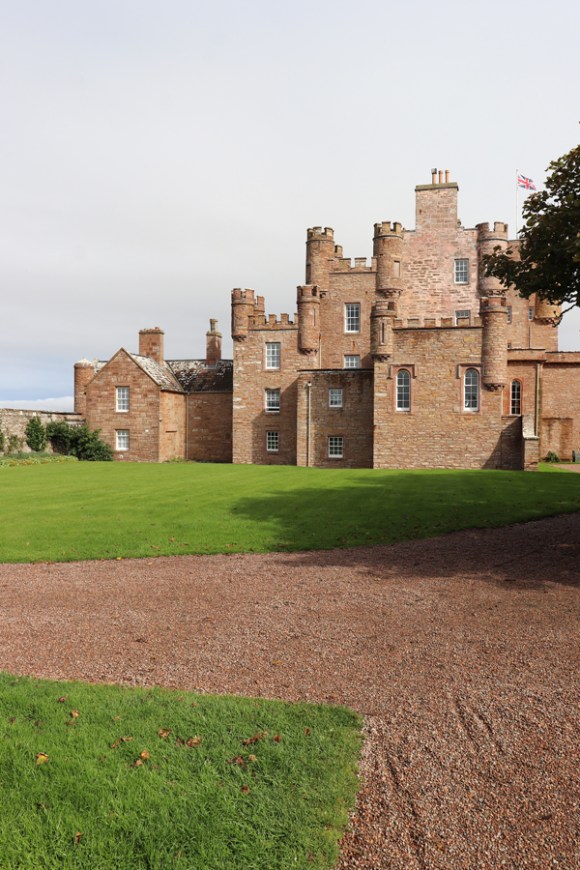
“It’s very romantic,” notes heritage architect John O’Connell, “and the walled garden is beautiful.” Teetering on the edge of the world, or at least the top of Britain, overlooking Hoy, the second largest Orkney Island, is the only private residence The Queen Mother ever owned. In August 1952, just widowed, she bought the derelict Barrogill Castle for a token £100 from a local landowner. It was love at first sight, and who could blame Her Late Majesty? It helped that her great chum Lady Doris Vyner just so happened to live next door, or rather next estate, at The House of the Northern Gate.

The Castle of Mey Caithness Coast © Lavender's Blue Stuart Blakley

Following a three year reconstruction, The Queen Mother spent four weeks every August and 10 days every October at The Castle of Mey, as she rebranded it, right up to her death in 2001 aged 101. She furnished it simply with purchases from local antiques shops complemented by a few family pieces. And a Linley occasional table. Curtains are draped below bathroom basins in that upper class domestic fashion. Prince Charles continues the holidaying tradition and stays in the castle for 10 days every July. The building dates from the late 16th century except for the double height front hall which was added in 1819 to the design of William Burn for James Sinclair, 12th Earl of Caithness.

The Castle of Mey Caithness Garden © Lavender's Blue Stuart Blakley

The Castle of Mey Caithness Walled Garden © Lavender's Blue Stuart Blakley

The Castle of Mey Caithness Glasshouse © Lavender's Blue Stuart Blakley

The Castle of Mey Caithness Flowerbeds © Lavender's Blue Stuart Blakley

The Castle of Mey Caithness Facade © Lavender's Blue Stuart Blakley

The Castle of Mey Caithness Scotland © Lavender's Blue Stuart Blakley

The Queen Mother's Castle of Mey Caithness © Lavender's Blue Stuart Blakley

The Castle of Mey Caithness Side Elevation © Lavender's Blue Stuart Blakley

Elizabeth Angela Marguerite’s younger daughter wasn’t just so keen on The Castle of Mey. Despite having a bedroom named in her honour, Princess Margaret never slept in the castle, preferring the luxury of the Royal Yacht. The Queen Mother’s favourite colour, Phoenix Blue, is everywhere from picture frames and towels to her raincoat on display in the front hall. There’s a well stocked drinks table in the drawing room. “The Queen Mother’s best loved tipple was one measure of Gordon’s Gin and three measures of Dubonnet served with lemon and ice,” explains her close friend Major John Perkins. He’s still a regular guest at the castle. “She always had ice in drinks and used her fingers, claiming ice prongs were an American invention!”

The Castle of Mey Caithness Wing © Lavender's Blue Stuart Blakley

The Queen Mother frightfully loved picnics,” he continues, “but when she formally dined in the castle, the seats on either side of her were called the ‘hot seats’ for special guests. At the start of the meal, everyone spoke to the person on their right and then swapped to the person on their left. That way no one was left out of conversations. She rang a bell for the next course to be brought out. Her three corgis would bark at the same time. After dinner, the gents would remain in the dining room drinking port, while the ladies would withdraw to the drawing room. If the gents lingered too long, The Queen Mother would start a rousing rendition of ‘O Come All Ye Faithful’! That meant get packing!”

The Castle of Mey Caithness Lawn © Lavender's Blue Stuart Blakley

The Major adds, “The Queen Mother had a terrific sense of humour. She was highly highly intelligent. She met all the world leaders of her time except for Hitler, Mussolini and Stalin.” On décor, “The Queen Mother didn’t like suspended lights. She liked soft lamps which cast more flattering light and shadows. The castle is exactly as she had it as her home. We haven’t added posh stuff!”

The Castle of Mey Caithness Keep © Lavender's Blue Stuart Blakley